



 ₹https://clinic.asgeyehospital.com/locator/-in-raipur/-in-shankar-nagar/asg-eye-hospital-in-shankar-nagar-raipur--5Fu0Oc/articles/brown-eyes-vs-blue-eyes-in-shankar-nagar-raipur-vision-genetics-eye-health-differences--41c98a4f-ad0a-496c-a239-979046b42086
ASG Eye Hospital, Shankar Nagar, raipur
Second & Third floor Madan Complex, Shakti Nagar Road, Shankar Nagar, raipur, chhattisgarh - 492004
Request A Call Back
ASG Eye Hospital Social Feeds in Shankar Nagar, raipur
Brown Eyes vs Blue Eyes in Shankar Nagar, raipur: Vision, Genetics & Eye Health Differences
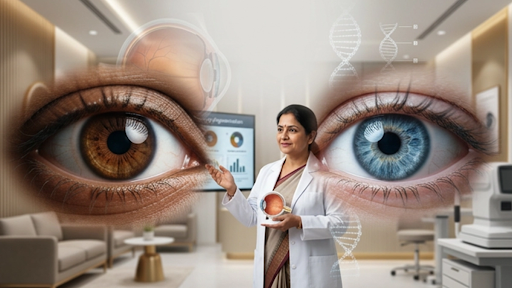
The genetic science of brown eyes vs blue eyes is in large part a story of melanin, inherited variation, and light scattering. Understanding eye colour genetics, including common eye colour differences and the role of iris colour, helps separate medical facts from popular myths. Whether you are in Shankar Nagar, raipur, or elsewhere, knowing how eye colour relates to vision and eye health can help you understand when professional eye care may be needed.
What Gives Eyes Their Colour?
The iris’ pigmentation, which includes melanin, is also responsible for skin and hair colour. In brown eyes, this pigment is more present in the front of the iris, while in blue eyes, there is very little. Blue eyes do not produce blue pigment. What we see as blue is due to light scattering, which is a result of low melanin content. In both cases, we see the same basic eye elements. What varies is the pigment amount and distribution.
Eye colour exists as a range, which is why we have hazel, green, grey, amber, or a mix of colours in the same person. MedlinePlus reports that eye colour ranges from very light blue to dark brown instead of falling into a few very distinct groups. Also, the colour a person’s iris has is mostly influenced by their genetics. What may appear to be a change in eye colour due to lighting, pupil size, camera settings, and surrounding colours is, in fact, not necessarily a change in the base pigmentation.
Eye Colour Genetics: Why Inheritance Is Complex
Older genetic theories suggested that brown eyes were dominant and blue eyes were recessive, which at the time made it seem like one gene determined eye colour. Today, we know that eye colour genetics is a complex issue. Many genes play a role in the production, movement, storage, and regulation of melanin.
HERC2, which is on chromosome 15, has a large role in this process. Some HERC2 variants reduce the action of OCA2, which in turn reduces melanin production and results in lighter eye colour. Genes like ASIP, IRF4, SLC24A4, SLC45A2, TYR, and TYRP1 also play a part. Therefore, it is not true that you can predict eye colour, brown eyes vs blue eyes, simply from a family tree.
Eye colour genetics is very complex, with many variables interacting. It is rare for two blue-eyed parents to have a brown-eyed child, while it is known that two brown-eyed parents may have a blue-eyed child. Family ancestry influences variant frequency, but eye colour alone cannot reliably indicate ancestry, personality, or health.
Brown Eyes vs Blue Eyes: Main Differences
The table summarises general tendencies and should not predict an individual patient’s vision or disease risk.
These eye colour differences are large-scale trends that should not be treated as absolutes. Dry eye, migraine, medicines, inflammation, and the reaction of the pupil also play a role in what we see.
Does Eye Colour Affect Vision Quality?
In most cases, brown eyes vs blue eyes pigmentation does not play a role in 6/6 vision, development of a need for glasses, astigmatism, or colour vision issues. Visual acuity is determined by the eye’s ability to focus as well as the health of the cornea, lens, retina, optic nerve, and visual pathways.
A study of 853 adults, which did not include people with cataract or prior eye surgery, reported no difference in best-corrected visual acuity between four iris colour groups. It also found that iris colour did not play a significant role in low-light visual acuity or contrast sensitivity.
Eye colour, therefore, is not an indicator that some eyes are weaker. Lighter eyes are not automatically weaker, and darker eyes are not automatically better. Discussion of brown eyes vs blue eyes should avoid the claim that one colour provides better eyesight.
Refractive error and eye disease have to be determined by proper testing, not by appearance.
Are Blue Eyes More Sensitive to Light?
People who have less melanin in their iris may at times see more glare because they have less pigment to absorb stray light. It is also important to note that normal blue eyes should not be confused with medical conditions that greatly reduce pigmentation.
Ocular albinism causes pigmentation issues in the iris and retina and may also bring about photophobia, reduced visual acuity, nystagmus, strabismus, and abnormal visual development. These issues are a result of a genetic pigmentation disorder, which is different from what one may think of when they see blue eyes.
This distinction is important when discussing brown eyes vs blue eyes. Normal eye colour differences do not mean a person has albinism.
Also, do not write off pain or painful light sensitivity as a feature of iris colour. Photophobia may present with dry eye, migraine, corneal injury, infection, or inflammation. Seek an eye exam when sensitivity comes on suddenly, affects only one eye, follows an injury, or is associated with redness, pain, headache, discharge, or blurred vision.
What Eye Health Issues Are Associated With Eye Colour?
In terms of health comparisons between brown eyes vs blue eyes, care is required. Population studies report associations, which are not necessarily definite results for every individual. Eye colour is only one factor among many, including age, family history, ultraviolet exposure, smoking, diabetes, blood pressure, occupation, and access to eye care.
Ocular studies report that light-coloured eyes have a greater risk of uveal melanoma, which is a rare form of cancer that develops in pigmented tissue within the eye. A population-based study reported a higher risk in people with grey, hazel, or blue eyes compared with brown eyes. A review also suggested that dark iris colour may be an indicator of lower risk of uveal melanoma.
This does not mean that blue eyes cause cancer or that brown eyes provide complete protection. Reports have also presented a different picture regarding cataracts.
In the Blue Mountains Eye Study, dark brown eyes were associated with a higher degree of nuclear cataract and a need for cataract surgery compared with blue eyes. Another report also found a connection between dark irises and age-related cataracts.
These findings show why eye colour differences should not simplify the issue to statements such as “light eyes are unhealthy” or “dark eyes are always protective.”
Protection Matters for All Eye Colours
Whether the comparison is brown eyes vs blue eyes, protecting your eyes from ultraviolet rays is important. The National Eye Institute says to wear sunglasses that block out 99% to 100% of UVA and UVB radiation, which you may get even on a cloudy day.
Also, try close-fitting frames and a broad-brimmed hat, which can in turn reduce exposure and glare. An iris should not be considered a built-in pair of sunglasses.
Brown-eyed people still require protection because there is a link between UV exposure and cataract, pterygium, pinguecula, and eyelid cancers. Blue-eyed people require the same care.
The practical lesson from brown eyes vs blue eyes is that visible colour does not remove the need for prevention.
What About Eye Colour Change?
Small changes may be seen in childhood as pigments develop. Eyes may also appear to change colour due to lighting, clothing, make-up, camera processing, or pupil size. However, a true new change in one adult eye does require attention.
This issue is of greater importance than a cosmetic comparison of brown eyes vs blue eyes. A stable, lifelong shade is usually an inherited trait, while a new change may require evaluation.
Common Myths About Brown Eyes vs Blue Eyes
One myth says brown eyes see better in sunlight and blue eyes see better at night. Pigment may affect glare comfort, but it does not create a reliable visual advantage.
Another myth says blue eyes are fragile. Normal lighter eyes are not diseased eyes, and eye colour genetics does not determine whether the cornea, lens, retina, or optic nerve is healthy.
Another myth claims that two blue-eyed parents can never have a brown-eyed child. Modern eye colour genetics explains why this rule is unreliable. Multiple genes create eye colour differences, and uncommon combinations can occur.
Claims that foods, supplements, home remedies, or unapproved drops can permanently change adult eye colour should also be treated cautiously.
Eye Care Tips for Every Eye Colour
The best way to care for brown eyes vs blue eyes is to put less attention on the colour and more on eye health. Wear glasses that block out UV rays, use protective gear for sports and in the workplace, manage your diabetes and blood pressure issues, do not smoke, follow safe contact lens care practices, and get regular eye exams at the intervals your eye-care professional recommends.
History is a better indicator of eye disease risk than visible colour. Tell your ophthalmologist about glaucoma, retinal disease, inherited disorders, childhood squint, high refractive error, or unexplained vision loss in your family. Iris colour may be noted, but it is by no means the full picture.
When Should You Visit ASG Eye Care in Shankar Nagar, raipur?
Book an eye exam if you experience reduced vision, frequent headaches, difficulty seeing at night, persistent glare, flashes, floaters, distorted vision, pain, redness, discharge, injury, or a new colour change.
The issue of brown eyes vs blue eyes may start out as curiosity, but symptoms themselves must be looked at separately.
At ASG Eye Care, our ophthalmologists will assess the eye’s structures, pressure, and refractive status to determine which changes are harmless and which may require treatment. No comparison of eye colour differences can replace a patient-specific evaluation.
Frequently Asked Questions
Do Brown Eyes Have Better Vision Than Blue Eyes?
No. In terms of brown eyes vs blue eyes, neither eye colour inherently improves or reduces visual acuity. Visual acuity is a product of refractive error and the health of the eye’s focusing and nerve structures.
Which Eye Colour Is More Prevalent Worldwide?
Brown eye types are very prevalent because genes associated with greater iris melanin are common in many populations. It is also a fact that eye colour genetics does not boil down to a single “brown eye” gene.
Are Blue Eyes Actually Blue?
Usually, they do not have blue pigment. What we see is due to low melanin and light scattering. This is one of the best-known differences in eye colour differences between dark and light eyes.
Do Blue-Eyed People Always Have Greater Sensitivity to Sunlight?
No. Some people may experience more glare, but sensitivity is a variable issue. With brown eyes vs blue eyes, severe or new photophobia should be evaluated, particularly when it occurs with pain, redness, migraine, or blurred vision.
Can Parents Accurately Predict a Baby’s Eye Colour?
They can make estimates, but ultimately it is not certain. Eye colour genetics involves OCA2, HERC2, and many other genes, which may produce an unexpected combination.
Can Eye Colour Increase Disease Risk?
Research reports connections between iris colour and conditions such as uveal melanoma or cataract, but colour by itself does not predict disease. Age, UV exposure, family history, and general health play a larger role in individual assessment.
Does Diet or Supplements Change Adult Eye Colour?
A healthy diet supports overall health and eye health, but we do not see changes in the genetic colour of the eye through diet. Claims that products can turn brown eyes blue, blue eyes brown, or permanently change eye colour should be treated with care.
Should Brown-Eyed People Wear Sunglasses?
Yes. Eye colour differences do not eliminate the risks associated with UV exposure. Choose sunglasses that block 99% to 100% of both UVA and UVB radiation.
Conclusion: Brown Eyes vs Blue Eyes and Your Eye Health in Shankar Nagar, raipur
The issue of brown eyes vs blue eyes is interesting, but in practice, the difference between the two is much less significant than many people think. As a whole, brown eyes vs blue eyes is a matter of pigmentation, not visual ability. In most cases, brown eyes have more melanin, while blue eyes have less, appearing blue through light scattering.
What we see as brown vs blue eye colour genetics is influenced by multiple genes that play out in different ways, rather than following a simple dominant-recessive model.
Normal variation in eye colour differences does not determine who has sharper vision, who will need glasses, or which diseases will develop. Eye colour may play a role in how comfortable someone is with glare and may also appear in statistics showing that some conditions are more associated with certain colours, but overall, it is only a small piece of what we should consider for eye health.
For all iris colours, protect your eyes from UV damage, notice any new symptoms, and consult an eye-care professional when your vision changes or the appearance of the eye does. If you are in Shankar Nagar, raipur and have concerns about your vision or a new eye colour change, a comprehensive eye examination at ASG Eye Care can help identify the cause and guide appropriate care.