
 ₹https://clinic.asgeyehospital.com/locator/chhatrapati-sambhajinagar/kranti-chowk/asg-eye-hospital-in-kranti-chowk-chhatrapati-sambhajinagar--1QtZuL/articles/latest-innovations-in-contact-lens-technology-smar--f923fb7f-3d33-486f-8757-4fe008f89c7a
ASG Eye Hospital, Kranti Chowk, chhatrapati sambhajinagar
AG Prime House No. 5-5-57, Railway Station Rd, New Usmanpura, Kranti Chowk, chhatrapati sambhajinagar, maharashtra - 431001
Request A Call Back
ASG Eye Hospital Social Feeds in Kranti Chowk, chhatrapati sambhajinagar
Latest Innovations in Contact Lens Technology & Smart Lenses
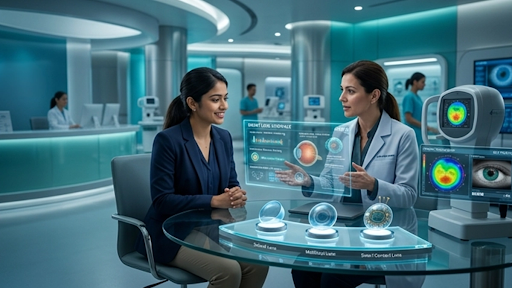
Contact lenses today have come a long way beyond their basic function as an alternative to spectacles. We see present-day technology which includes better materials, computer-designed optics, specialised myopia-control patterns and, in some cases, healthcare delivery. Also in the works are smart contact lenses which may report on eye or tear-based information. As a whole, these changes are part of a new age of vision innovation in which a thin medical device not only corrects vision but also, in some cases, supports diagnosis or treatment.
It is important to understand which contact lens technology options are currently available and which are still in the research stage. Silicone hydrogel lenses, daily disposables, toric lenses, multifocal lenses, myopia-management lenses and a drug-eluting allergy lens are available and in use in some markets. Many electronic sensor lenses for glucose detection, pressure measurement or augmented reality are still in the research phase. Thus, it is to the benefit of the patient that he or she views futuristic claims with caution and discusses a device’s intended use with an ophthalmologist.
How Contact Lens Technology Has Evolved
Earlier soft lens technologies were designed for basic refractive correction and water content. In terms of present contact lens technology, we see greater attention to oxygen permeability, surface wettability, tear-film stability, friction, edge design, deposit resistance and movement during blinking. These factors play a role in clarity and comfort, while tear quality, eyelid health, environment and daily habits also play a role.
This does not mean that the latest products are suitable for all eyes. Advanced contact lenses are still prescription medical devices. We do a proper fitting which includes evaluation of corneal shape, lens movement, centration, vision and the health of the eye. The CDC reports that contact lenses vary by material, wear schedule and replacement, and that you should have an eye-care professional perform an examination and provide appropriate instruction.
Better Materials and More Comfortable Surfaces
Silicone hydrogels brought a major shift in contact lens technology as they allow more oxygen to reach the eye than many traditional hydrogels. Presently, we see growth in research and development of the front surface of lenses. We have water-gradient concepts, special coatings and wetting agents which in turn reduce friction and help the tear film to spread more effectively over the lens.
Some advanced contact lenses have surface treatments which reduce deposits or friction. In the research phase, we also see work involving biomimetic and antimicrobial coatings. This is an important area of development, but persistent discomfort may be a sign of dry eye, allergy, poor fit, lens damage or excessive wear.
Clearer Vision for Astigmatism and Presbyopia
Toric lenses, which are used for astigmatism, must remain in the proper position. In modern contact lens technology, we see the use of stabilisation zones, thinner profiles and precise manufacturing which can reduce unexpected movement of the lens. A better-positioned optical zone may provide more stable vision when you are reading, driving or using a screen.
For presbyopia, advanced contact lenses use concentric zones and aspheric multifocal designs which support distance, intermediate and near vision. Pupil size, lighting conditions and visual expectations play a role in adaptation, which is why trial fitting and follow-up adjustments may be required.
Myopia-Control Contact Lenses
One of the key developments in contact lens technology relates to myopia control in children. These lenses provide clear central vision while incorporating specialised optical zones designed to influence visual signals associated with excessive eye growth. The FDA reports on MiSight 1 Day, a daily-wear soft lens designed to reduce myopia progression, which means this concept has moved into regulated clinical use in at least some markets.
My experience with advanced contact lenses for myopia management has found that they are not right for all children. What we do see is that prescription, corneal health, hygiene, maturity and family support play large roles. Also, in the specialty area of orthokeratology, rigid lenses are worn at night to temporarily reshape the cornea. Both approaches require professional fitting and ongoing monitoring from doctors. We also note continued development beyond what is available today in terms of visual clarity and long-term myopia management.
Drug-Releasing Lenses
Eye drops have a tendency to leave the ocular surface quickly through blinking, tearing and drainage. In the area of drug delivery related to contact lens technology, research is focused on keeping medication near the eye for a longer period and releasing it in a controlled way. Studied methods include drug-loaded polymers, films, nanoparticles, microstructures and electronically actuated delivery. Reviews from the US National Library of Medicine report on the potential for extended ocular residence and improved drug availability.
This concept has moved beyond the purely theoretical stage. The FDA gave approval to a daily disposable contact lens which includes ketotifen for reducing itch from allergic conjunctivitis while also correcting certain refractive errors. It has a specific indication, meaning not all drugs can simply be incorporated into a lens. Still, it represents an important step forward in the development of advanced contact lenses and provides a practical example of vision innovation combining correction with therapy.
What Are Smart Contact Lenses?
Smart contact lenses refers to lenses which include sensing, communication, therapeutic or display functions in addition to the normal corrective features of conventional lenses. We have seen research involving microfluidic channels, miniature sensors, antennas, wireless circuits and colour-changing materials in prototypes. Tear fluid provides physical and chemical information, making the eye an area of interest for wearable technology.
Potential uses include tracking pressure changes, temperature, pH, glucose or inflammatory markers. Some smart contact lenses may report information wirelessly, while others may produce a colour change visible through a camera. This area of contact lens technology could support more personalised health monitoring, but results can be affected by tear flow, evaporation, lens movement and calibration. A tear-based measurement should not be considered equivalent to a blood test or a full eye examination.
Pressure Monitoring and Glaucoma Research
Potential uses include tracking pressure changes, temperature, pH, glucose or inflammatory markers. Some smart contact lenses may report information wirelessly, while others may produce a colour change visible through a camera. This field of contact lens technology could support more personalised health monitoring, but results remain subject to tear flow, evaporation, lens movement and calibration. A tear-based measurement should not be treated as equivalent to a blood test or full eye examination.
This application highlights both the promise and challenges related to contact lens technology. A monitoring lens has value only when it has been properly validated, has clinical relevance and is interpreted by an eye-care professional. Patients should not assume that a consumer device is a diagnostic tool for glaucoma.
Glucose and Other Tear Biomarkers
Smart contact lenses have attracted interest because they may offer a needle-free monitoring approach. In laboratory research, we see lenses reporting on tear-based glucose, which researchers may use to infer blood glucose levels. However, tear glucose does not always mirror blood glucose. For widespread use, what is required is consistent sample collection, accurate calibration, protection from external interference and information that is safe to use when making medical decisions.
Researchers also report on inflammatory markers, electrolytes, stress-related molecules and indicators of dry eye or infection. Optical sensors may use fluorescence, photonic structures or colour changes, while electronic systems require circuits, antennas or wireless power. This field of vision innovation is continuing to develop, but unregulated products should not be used to diagnose systemic disease.
Augmented-Reality Lenses
Display-enabled smart lenses aim to place navigation or alerts directly into your field of vision. That represents a significant engineering challenge. The lens has to remain clear, breathable and stable while housing small components and receiving power without producing harmful heat.
This is a very forward-thinking area of contact lens technology which is currently not a typical replacement for phones, glasses or headsets. At early stages, use may focus on special purposes such as accessibility, industrial support or specialised medical applications. Progress in this area will depend not only on display quality but also on corneal safety, reliable focus and long-term wearability.
Safety Still Comes First
At present, there is no contact lens technology which removes the importance of hygiene. Contact lenses are medical products and, if not worn properly, may cause microbial keratitis and other complications. The CDC reports that wearers should follow professional advice for wearing, cleaning and storing lenses. The FDA also advises users not to expose their lenses to tap, bottled, distilled, lake or ocean water.
Both basic and advanced contact lenses should be used according to the prescribed schedule. For reusable lenses, the appropriate cleaning and storage routine must be followed, and water should never be used as a substitute for proper lens solution. Water may change the shape of a soft lens, cause it to stick to the eye and introduce harmful microorganisms.
Remove the lens and see an eye-care professional at the first sign of increasing redness, pain, light sensitivity, discharge, sudden blur or a persistent foreign-body sensation. Do not use random eye drops to mask symptoms, as contact lens-related infections can also present with these symptoms.
Choosing the Right Lens
The safe use of contact lens technology begins with an in-depth eye examination. The ophthalmologist looks at the prescription, corneal shape, tear film, eyelids, work pattern and lifestyle. A child being managed for myopia has a different plan from an adult who is a candidate for multifocal correction, which is also different from the approach for a person with dry eye symptoms.
Ask whether a product is actually approved for its intended use, how frequently it should be used or replaced, whether it is safe for overnight wear and which solutions are compatible with it. The term "advanced" is broad and does not in itself guarantee quality.
At chhatrapati sambhajinagar ASG Eye Hospital, our ophthalmologists can assess your eyes and help match the appropriate lens material, design and care instructions to your individual eye health and needs.
The Future of Contact Lens Technology
In the future, contact lens technology may combine sensing, secure communication and controlled treatment on one platform. Researchers are looking at flexible electronics, biodegradable materials, wireless power and antimicrobial surfaces. We may eventually have lenses that report on a clinical change and deliver a dose of medicine, but that remains on the horizon and will require large-scale safety and effectiveness research.
Before widespread adoption, smart contact lenses must demonstrate optical clarity, oxygen permeability, comfort, sterility, electrical safety, reliable communication, privacy protection and genuine clinical benefit. The best vision innovation will be technology that solves a patient's problem without compromising corneal health.
Conclusion
Modern development in contact lens technology has introduced improved materials, precise optical designs, myopia-management options and targeted drug delivery. Some advanced contact lenses are already used as clinical tools, while the development of sensor-enabled systems remains largely in the research stage.
We see considerable promise in smart contact lenses, but responsible growth requires accurate testing, regulatory approval and protection of the eye. For patients in Kranti Chowk, chhatrapati sambhajinagar, the best approach is to choose contact lens technology based on professional assessment, intended use and long-term eye health. The best vision innovation is technology that improves vision while supporting the long-term health of the eyes.
Frequently Asked Questions
1. What is the latest contact lens technology available?
At present, we have silicone hydrogel materials, improved daily-wear options, stable toric designs, multifocal lenses, myopia-management devices and a drug-eluting lens for a specific approved allergy indication.
2. Are smart contact lenses available for daily use?
Most of what has been developed in terms of smart contact lenses that sense glucose levels, measure pressure or provide digital displays remains in the research stage. What is available and approved varies by country, so it is beneficial to check with your ophthalmologist and the appropriate regulator.
3. Can advanced contact lenses slow myopia?
At present, there are advanced contact lenses designed for myopia management which also include features intended to reduce progression in some children. They require professional fitting, good hygiene practices and regular follow-up.
4. Can lenses release eye medicine?
Drug-eluting lenses are an important development in contact lens technology. We have an FDA-approved daily disposable lens which releases ketotifen to help prevent eye itch from allergic conjunctivitis while also correcting certain refractive errors.
5. Can a smart lens measure blood sugar?
Experimental smart contact lenses have been developed to report on glucose-related tear signals, but they should not be used instead of blood glucose testing. Calibration and clinical interpretation remain important challenges.
6. Are high-tech lenses safer?
Technology by itself does not eliminate infection or fitting risks. All advanced contact lenses require appropriate care, proper replacement, a valid prescription and avoidance of unsafe water exposure.
7. Can vision innovation replace an eye examination?
No. Vision innovation may introduce improvements in correction, monitoring or treatment, but an eye examination is still required to assess the cornea, retina, optic nerve, eye pressure and overall ocular health.
8. Who may not be suitable for contact lenses?
People with an active infection, severe uncontrolled dry eye, certain corneal conditions or an inability to follow hygiene instructions may require an alternative. Referral to an ophthalmologist is recommended to determine suitability based on examination findings.